A person who is usually clean and doesn’t like to pile up waste in their house will definitely clean up their house before leaving for a long trip.
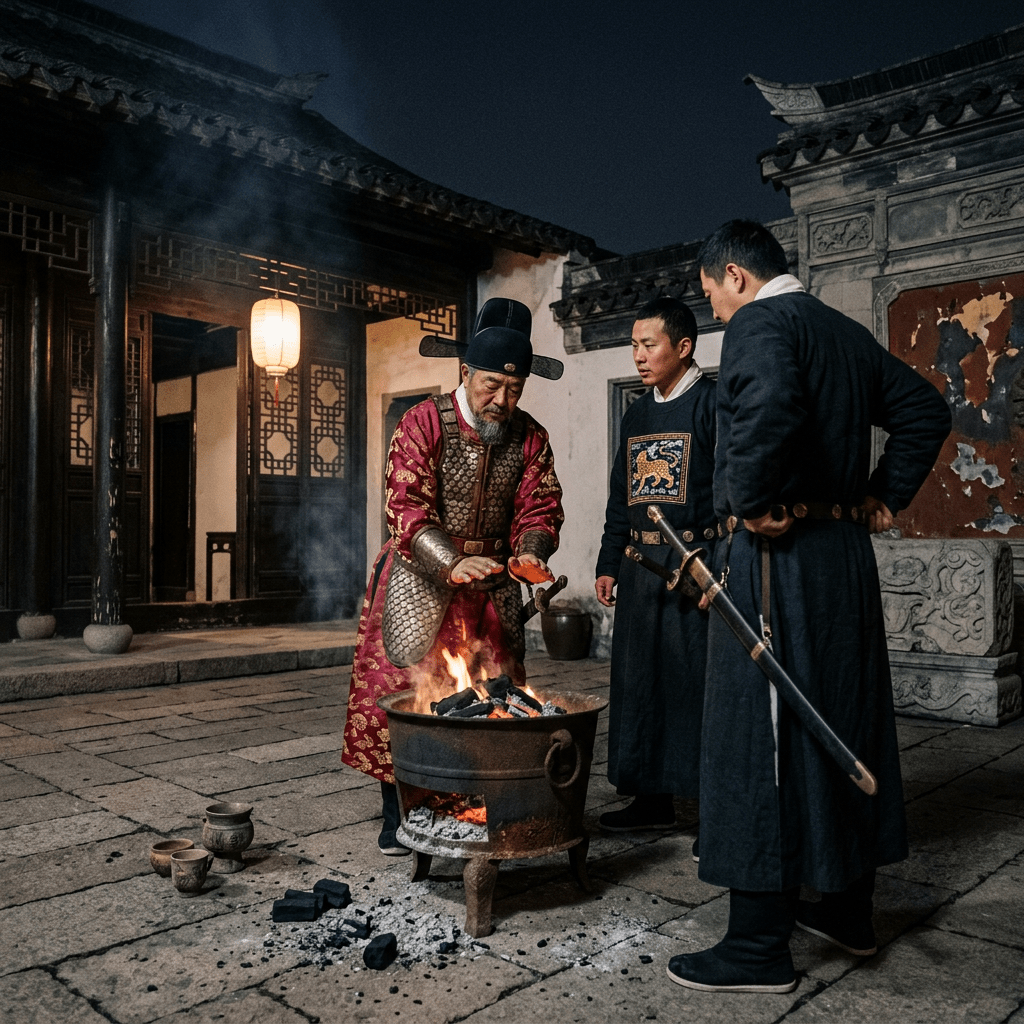
This can be seen from Lin Shaoqing. Every time he leaves the yamen, he will empty the used paper and the charcoal brazier that was burned in winter, tidy up, and put everything in order before leaving.
Seeing that the writing brushes, ink, paper, and inkstones in Steward Niu’s house were all arranged in an orderly manner without any crookedness, and after inquiring about this from the servants, Wei Fu felt that there was something wrong with the charcoal brazier at first glance and wanted to bring it back.
Fortunately, the servants of the Imperial Household Department1 were greedy and thought that the unkempt charcoal brazier was not an important item, so they let Wei Fu take the charcoal brazier away directly.
The contents of the charcoal brazier had been burned to ashes, but Wei Fu moved the charcoal brazier very carefully and did not scatter the charcoal ashes in the charcoal brazier, so the fragments of ashes still maintained their original shape.
Beneath the scattered ashes and fragments on the surface lay a whole, square piece of ash. The size and shape of the ash were all too familiar; any official from the Court of Judicial Review would recognize it.
Liu Yuan glanced at it and immediately blurted out, “It must be a piece of paper, burned.”
No sooner had he spoken than a gust of wind blew, swirling the square piece of ash into the air, leaving only a jumbled pile of ashes in the charcoal brazier.
Watching this fleeting scene, Liu Yuan sighed inexplicably.
These fragments of ash were, of course, inadmissible as evidence. Even without the wind, the charcoal brazier couldn’t be brought to court. However, to the officials of the Court of Judicial Review, these intact fragments were not entirely useless.
The last thing Steward Niu did before leaving the Imperial Household Department must have been to look at the contents of this piece of paper. After looking at it, he immediately burned it, not even bothering to empty the paper before hastily leaving and never returning.
As for Steward Niu’s hometown and where he went back to, Wei Fu had naturally inquired about it. After recording everything he found out and handing it over to Liu Yuan and the others, Wei Fu added, “I heard that when Steward Mao hadn’t moved out of the courtyard, Steward Niu and he had a pretty good relationship. After all, they lived under the same roof. Because Steward Niu was clean and tidy, he would often help Steward Mao, who was too lazy to clean, tidy up the house.”
Compared to Steward Niu, who liked to do everything himself, Steward Mao was obviously a pleasure-seeker, and he was naturally happy to have someone do the work for him.
“Steward Mao was well-off and would often bring food and items from places like Hongyanlou to Steward Niu as payment for his hard work cleaning the house. The two got along quite well,” Wei Fu said. “However, after Steward Mao moved away, because their duties differed, they gradually lost contact.”
Although both came from out of town to work as Stewards in the Chang’an Internal Affairs Office, their fates were worlds apart: one managed the market, which was quite lucrative, and he received many bribes from the market officials. Although Steward Mao had other sources of income, he never complained about having too much money. Steward Niu, on the other hand, managed the distribution of herbs to sterilize water, which offered no real benefits. The bailiffs and village heads wouldn’t bother to bribe him; it was a strenuous but unprofitable job.
No wonder, despite both being stewards, one lived in a grand mansion and was waited on hand and foot, while the other still lived in the quarters for stewards in the Imperial Household Department.
“This Steward Niu is just like Steward Mao,” Wei Fu said, recounting Steward Niu’s fate. “He also got his position through some kind of ‘advice and help,’ but his life after becoming steward is far worse than Steward Mao’s. This time, he caused so much trouble by making the people sick with diarrhea, and I wonder what his motives are.”
Wei Fu was also puzzled by the last sentence: the well water volume was large, and the laxative wasn’t very strong. They said Steward Niu wanted to kill people… yet no one had been harmed. The whole affair was all bark and no bite, and he quietly “returned home.”
Since the two incidents were connected, it seemed that Steward Niu, who had “returned home,” wouldn’t be so easy to find. The officials of the Dali Temple were well aware of this, but after returning to the Dali Temple with the herbs to sterilize water distributed by the yamen to Wei Fu’s family and confirming that it was indeed the substance that caused the problem, they still sent someone to Steward Niu’s “hometown” to investigate. At this point, the matter of the diarrhea was cleared up; as for the motive, only finding Steward Niu would reveal the answer.
Wei Fu’s discovery connected the two events. Although the connection between the two out-of-town officials was still unclear, it brought progress to the case.
With this discovery, it was unknown what Lin Shaoqing’s arrangements would be tomorrow.
Liu Yuan looked up at his superior. After returning, his superior had tidied up the files scattered on the desk. Just as Liu Yuan was about to ask Lin Fei about tomorrow’s arrangements, Bai Zhu suddenly nudged his arm.
Liu Yuan looked at Bai Zhu, puzzled, only to see Bai Zhu shake his head. Before Bai Zhu could speak, Lin Fei, who had finished tidying up the desk, said, “I’m hosting a banquet at home tomorrow. You can decide on the case!”
With that, he handed a pre-written leave slip to Bai Zhu, asking him to deliver it to Zhao Mengzhuo before leaving.
Seeing how decisively he left, Liu Yuan couldn’t help but gasp. He nudged Bai Zhu’s hand and said, “This is the first time I’ve seen our Lin Shaoqing leave so decisively when there’s progress in a case. He just… abandons it like that?”
Bai Zhu also looked puzzled but shook his head and said, “Well, since Lin Shaoqing has told us to make our own decisions, we should at least find something out tomorrow. Otherwise, when Lin Shaoqing comes back and asks about it the day after tomorrow, we’ll lose face!”
The Shaoqing of Dali Temple was no pushover.
Just as he was thinking this, Liu Yuan suddenly sighed and said, “I almost forgot, Lin Shaoqing is hosting a banquet at his home tomorrow, and Chef Wen won’t be in the kitchen. I’m afraid there won’t be any new dishes to try tomorrow!” His tone was quite regretful.
Bai Zhu: “…” Although the Shaoqing of Dali Temple was no pushover, he was always thinking about food.
After being nagged by Liu Yuan, Wen Mingtang handed the menus for tomorrow’s three meals from the public kitchen to Tangyuan and Ah Bing, then went to prepare for the family banquet at the Jingyun Marquis’s residence the next day.
Compared to the public kitchen’s large-scale dishes, these banquet dishes were more refined and elaborate, catering to the tastes of both the host and guests. Each dish was quite particular. In the afternoon, someone from the Jingyun Marquis’s residence even made a special trip, asking Wen Mingtang to bring some red yeast rice, saying that the Jingyun Marquis’s residence was out of it and wondering if the Dali Temple’s public kitchen had any.
Tomorrow’s banquet menu included a dish of braised pork, which requires red yeast rice2 for coloring, making its color more vibrant and bright.
Braised pork was a very common dish, but each chef had their own preferences in terms of its color and flavor.
It was also very common to use red yeast rice to color meat dishes; there were quite a few chefs in the city who added red yeast rice to their braised pork. Moreover, since it was Chef Xing who was making this dish, Wen Mingtang naturally wouldn’t interfere.
As for the simple task of preparing red yeast rice, she had already made it and planned to take it over tomorrow.
(End of Chapter)
Footnote
- I am using the Imperial Household Department in place of the internal affairs department, as that is the correct term. This department was responsible for managing the emperor’s household affairs, palace supplies, servants, finances, and various internal palace matters.
- Red yeast rice (Chinese: 红曲米, hóngqūmǐ) is rice that has been fermented with the mold Monascus purpureus. It has been used in Chinese cooking for over a thousand years as a natural red coloring agent and also adds a subtle savory, slightly sweet, fermented flavor.
The FL is going to ML’s house for the first time!!!.
 Translating one chapter one day at a time
Leave a comment